ADOPT-A-DUMPSTER™ · WET TRASH 101
What happens when rain mixes with garbage?
Rain that enters an open or damaged waste container can soak trash and cardboard, add weight, mobilize residue and create waste-contact water. Wet Trash 101 explains the pathway in plain language—and the simple source-control steps that help break it.
Rain + exposed waste = avoidable contact water.
“Wet trash” is waste, recycling, organics or residue that has been exposed to precipitation or other water. The concern is not that every open dumpster is automatically a violation. The concern is the physical pathway: precipitation contacts waste, water picks up material, containment determines whether it escapes, and site drainage determines where it goes next.
That makes wet trash a practical education topic shared by stormwater teams, solid-waste programs, property managers, haulers, employees and residents.
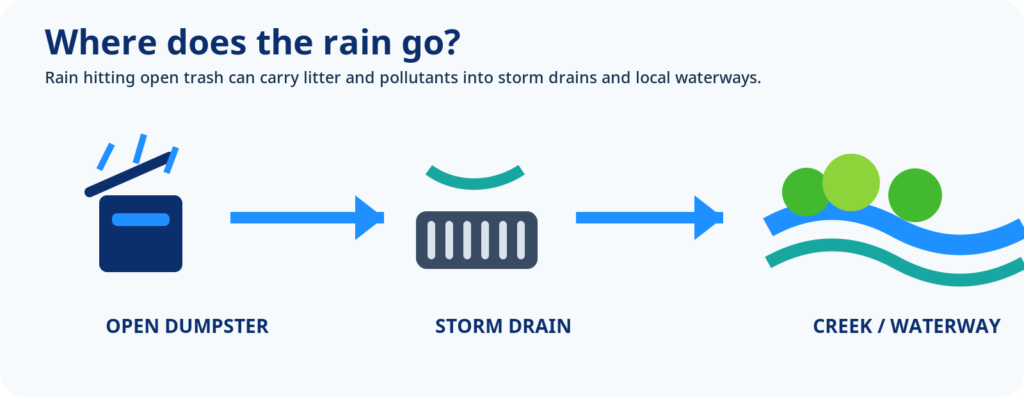
The five-part Wet Trash story
1. Rain gets in
Open lids, uncovered roll-offs, overflow and damaged containers allow precipitation to contact waste.
2. Waste gets wet
Cardboard, paper, food waste, organics, textiles, dust, grease and other materials can hold water or release residue.
3. Water gets out
Contact water can escape through rust-through holes, failed seams, overflow, compactor connections or across a dirty enclosure pad.
4. Pavement carries it
Site slope, gutters, trench drains, catch basins and storm drains determine the next part of the journey.
5. Source control breaks the chain
Close lids. Repair leaks. Prevent overflow. Sweep loose waste. Protect cardboard. Keep wash water and residue out of storm drains.
Start with the part that matters to you
Rain Adds Up Fast
See how one inch of rain turns exposed area into gallons—and gallons into water weight.
Wet Cardboard & Recycling
Why recovered paper is supposed to stay dry, and why moisture changes material quality and settlement.
Leaks, Rust & Container Condition
Rust is a warning. Loss of containment is the bigger issue. Learn what to look for.
Dumpster to Drain
Follow the pathway from an enclosure across pavement to the storm system and downstream waters.
The 60-Second Dumpster Check
Five quick actions employees and property teams can take before rain.
Wet Trash for Cities
A municipal source-control framework for education, inspection, drainage verification and local measurement.
Keep learning
Dumpster Juice / Waste-Contact Water
What the liquid is, what it can carry and why prevention beats cleanup.
Food Waste + Rain
Wet-weather housekeeping for restaurants, groceries and food-service sites.
Standing Water & Mosquitoes
Why water-holding trash containers and loose items deserve vector-control attention.
Overflow & Windblown Trash
How capacity, lid closure, wind and rain turn loose material into escaped trash.
What Not to Hose Into a Storm Drain
Why dry cleanup and controlled wash-water handling are better source control.
Field Photo Guide
A seven-photo sequence that documents conditions without turning education into a gotcha exercise.
What the evidence supports—and what it does not
Good education separates measured facts from assumptions. We can calculate gross rainfall volume and water weight directly. We can document whether lids are open, containers leak, cardboard is exposed, residue is present and drainage paths lead toward storm inlets. But site-specific pollutant pounds, hauling dollars, road damage or recycling losses need local measurements before they should be presented as local facts.
That distinction is central to Adopt-A-Dumpster™ education: explain the problem clearly without exaggerating it.
DOWNLOAD THE WET TRASH EDUCATION SERIES
Prefer a printable handout? Start with the public guide, download the complete education pack, or use the municipal brief for agency and leadership conversations.
The simplest message
Keep rain out. Keep waste in. Protect what is downstream.
Want practical materials you can print or share? Visit the Education Resource Library. Municipal teams can also visit For Cities for program information.
How enclosure design connects to wet trash
Container lids, gates, roofs, pavement and drainage all affect how a commercial waste area behaves during rain.