Rain does not stop at the dumpster.
Storm drains move water away fast. In many communities that water reaches creeks, rivers and downstream waterways without treatment. Keeping rain out of trash areas helps stop pollution closer to the source.
Explore Wet Trash 101 → | NEW: Commercial Employee & Manager Training → | Volunteer Academy → | Inspector Academy →
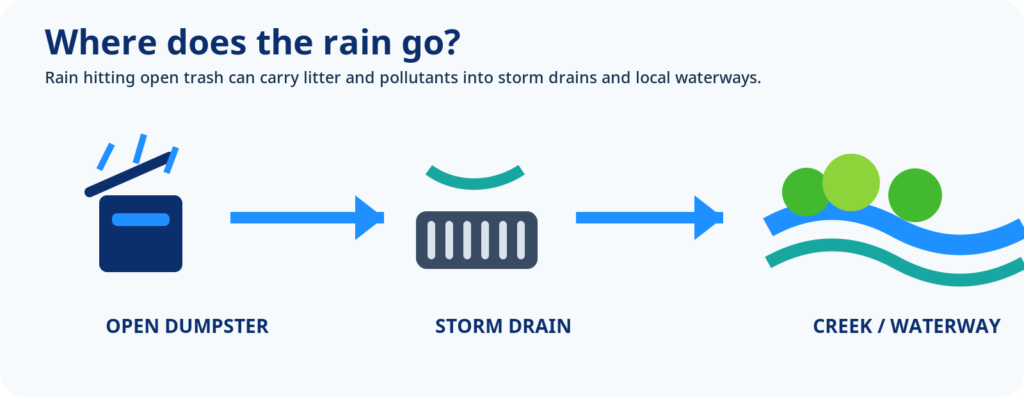
How stormwater moves from the dumpster area to downstream waterways

1. Rain reaches the trash area.
Open lids, uncovered enclosures and dirty pavement give rain direct contact with trash and residues.

2. Runoff leaves the site.
Water follows the pavement and drainage path toward the storm drain carrying what it picked up along the way.

3. The creek receives it.
Storm drains are drainage infrastructure, not a guarantee of treatment before water reaches downstream waterways.
Close what can close. Cover what needs a permanent solution.
Closing dumpster lids is the immediate habit. A covered enclosure or roof retrofit can help keep rainfall out of the larger trash area and support good stormwater practices over the long term.
Covering a dumpster area supports compliance. It does not guarantee compliance. The city decides compliance.
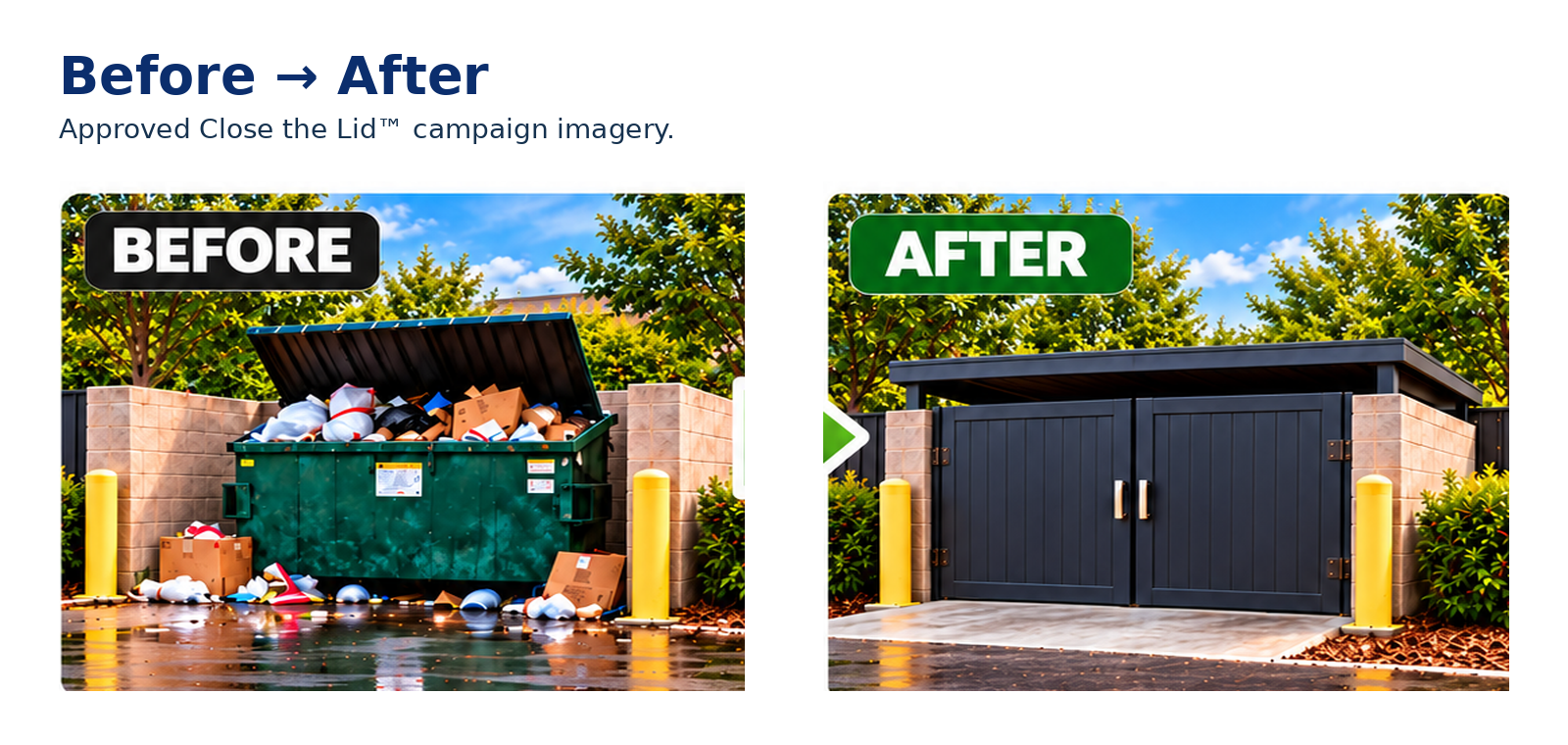
Illustrative program composition. Actual site conditions and improvements vary.
One inch of rain adds up fast.
One inch of rain on one square foot is about 0.623 gallons of water.
Estimated gallons = enclosure footprint × rainfall inches × 0.623
A 200-square-foot enclosure receives about 125 gallons from one inch of rain.
It is an estimate, not a pollutant measurement.
The runoff estimate helps explain how much rainfall can land on an exposed enclosure footprint. It does not claim that every gallon contains the same pollutants or that all rainfall becomes contaminated runoff.
The site will keep growing with practical education.
Articles and resources will be added here as the program launches, so a part-time site manager can keep the public education side current without rebuilding pages.
Stormwater Basics
Where runoff goes, why trash areas matter and what storm drains are designed to do.
Owner Best Practices
Simple housekeeping, lids, gates, inspections and documentation that help keep a site ready.
Community Action
How residents, sponsors, schools and cities can participate without turning the program into public shaming. Explore student learning, supervised service projects and adult field opportunities →
Where Does Stormwater Go?
Follow runoff from pavement and trash areas into the storm drain and downstream waterways.
Why Closing the Lid Matters
The immediate habit, what it helps with and why some sites still need a permanent cover.
The Rain Math
See the simple formula used to estimate rainfall landing on an exposed dumpster enclosure footprint.
Underwrite public education people can use and share.
Close the lid now. Cover what needs a permanent fix.
COMMERCIAL DUMPSTER & TRASH ENCLOSURE GUIDES
Start with the enclosure, then follow the water.
Practical guides for property owners, facility teams, designers and cities working around commercial dumpster and trash enclosure areas.
Dumpster & Trash Enclosures
The main commercial guide: components, gates, materials, access, drainage, covers and maintenance.
Enclosure Design
Size, gate swing, collection access, materials, bollards, drainage and future-proofing.
Covered Enclosures
Roofs, rain exposure, stormwater considerations and what a cover does—and does not—solve.
Requirements
What to verify with cities, haulers and design teams before a new build or retrofit.
COMMERCIAL ENCLOSURE LIBRARY
Dumpster enclosure and trash enclosure guides
Practical guides for property owners, facility teams, cities and anyone planning or maintaining a commercial dumpster area.
Dumpster & Trash Enclosures
The main commercial guide: components, gates, materials, drainage, roofs and daily operations.
Dumpster Enclosure Design
Size, access, gates, materials, collection geometry, drainage and future retrofit planning.
Covered Dumpster Enclosures
Roofs, rain exposure, stormwater source control and the design questions to solve before covering a site.
Dumpster Enclosure Requirements
What to verify with the city, hauler and design team before construction or retrofit work.