ADOPT-A-DUMPSTER™ · WET TRASH 101 · THE PATHWAY
From Dumpster to Storm Drain
Water follows gravity. Understanding the site’s drainage pathway is one of the most useful things anyone can learn about a dumpster enclosure.
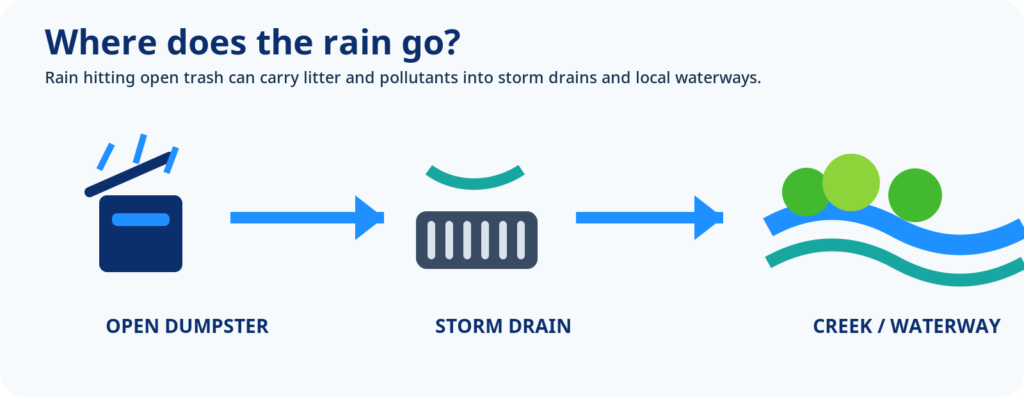
The pathway in five steps
- Exposure: rain falls into an open container or onto loose or overflowing waste.
- Contact: water touches waste, residue, sediment, grease, food or other materials.
- Escape: liquid leaks, drains, splashes or moves across the enclosure pad.
- Conveyance: pavement slope, gutters, trench drains or catch basins carry the flow.
- Downstream: stormwater infrastructure can convey runoff toward local receiving waters.
Storm drains are not sanitary sewers
One of the most important public-education ideas is that storm drains and sanitary sewers serve different purposes. In many communities, stormwater flows through drainage systems to creeks, rivers, estuaries or the ocean without the same treatment used for sanitary sewage.
Unknown drains deserve follow-up
If a dumpster enclosure contains a trench drain or floor drain, the destination should be known. It may connect to sanitary sewer, storm drain, a private treatment system or something else. “Unknown” is not a conclusion; it is a reason to verify plans or trace the connection.
The strongest photo sequence
Wide enclosure view → source condition → wet trail or residue → nearest drain → downstream context. This tells a much clearer story than a single close-up.
Source control works upstream
Keeping waste covered, repairing leaks, preventing overflow and sweeping loose material means less material is available to become runoff pollution in the first place.
Download the Adopt-A-Dumpster™ Dumpster to Storm Drain PDF for a printable version of this lesson.
View / Download PDFSources & further reading
← Wet Trash 101 · ← Leaks, Rust & Container Condition · 60-Second Dumpster Check →