Turn dumpster runoff into a visible community program.
For city managers, stormwater and public works teams: You can review our voluntary community-mapping model, request clean-water outreach material and ask about a scoped pilot with privacy-conscious progress reporting. Start now: contact us to discuss your jurisdiction’s goals. What happens next: we review data permissions, proposed activities, funding and responsibilities together. This is a proposed partnership pathway, not a claim that any city has endorsed the program.

Public engagement outside. Better records inside.
Residents and businesses see a positive public program. Authorized city users can work from a private jurisdiction view that may include non-public sites and inspection records.
Education, participation, mapping and documentation in one system.
The program is designed to support municipal stormwater outreach and site-improvement efforts without turning the public experience into an enforcement map.

Public Education
Give residents and businesses a simple message they can remember: Close. Cover. Protect.™

Privacy-First Mapping
Show zone-level public progress while keeping non-opted-in sites private.

Sponsor Participation
Create a path for businesses and community partners to help fund visible improvements.

Documented Progress
Use StormwaterIQ™ records, photos, inspections and status tracking to document work over time.
The city sees more than the public map.
Authorized municipal users can work from a private StormwaterIQ™ jurisdiction view that may include non-public sites, inspection records, filters, ownership information, program status and reporting tools.
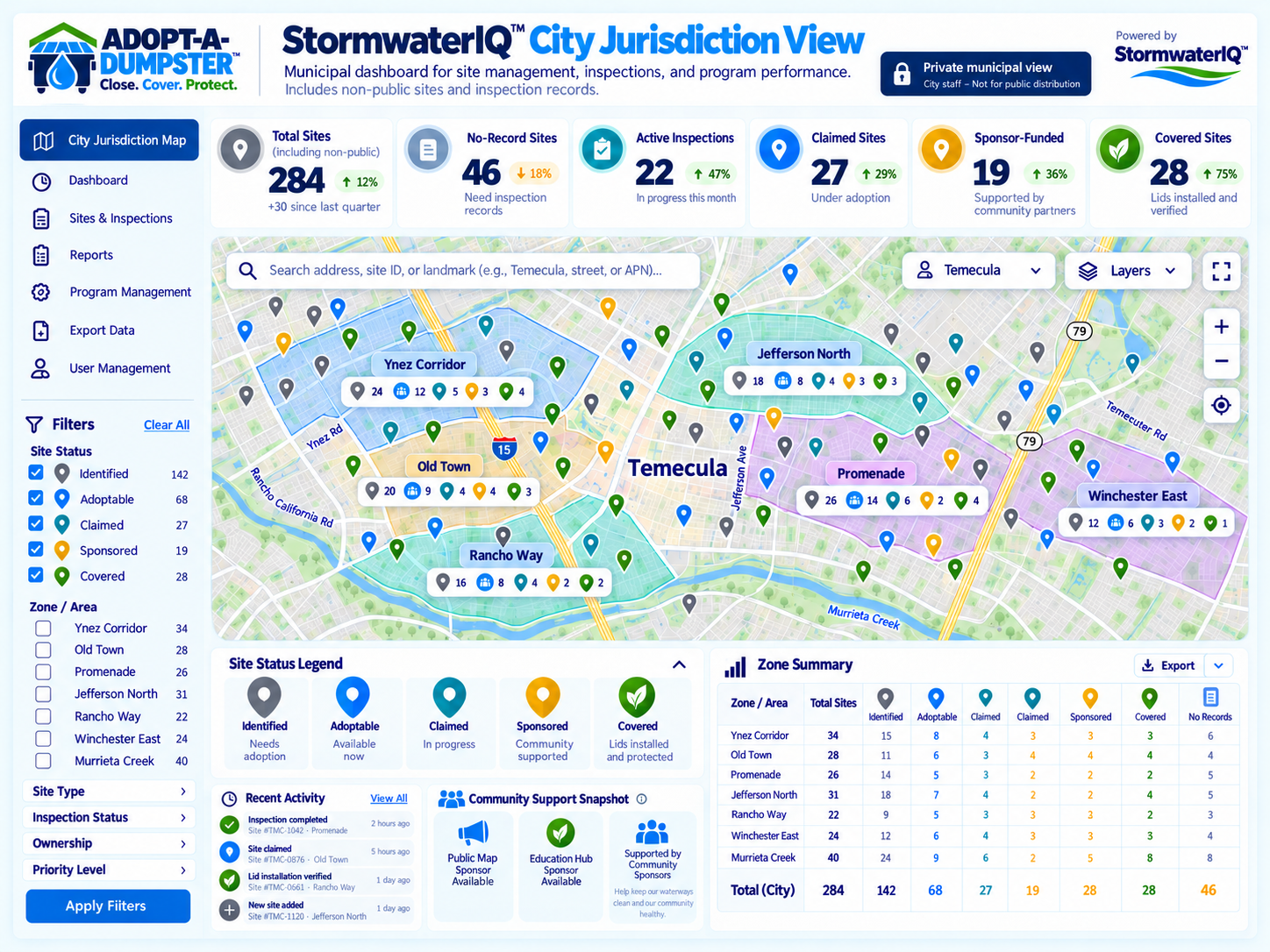
Private municipal interface preview using example data. It does not represent an existing municipal partnership or live deployment. Sponsor recognition is intentionally kept outside the operational city workspace.

Keep the private city workspace operational.
The private municipal workspace is designed for authorized staff and operational records. Commercial sponsor advertising is kept outside the working dashboard.
If a sponsor helps fund a city or corridor pilot, acknowledgment can appear on the public program page, public map, launch materials, impact report, event signage or a public-facing pilot summary. The private jurisdiction workspace stays clean.
Start with a manageable area. Prove the model. Expand.
1. Define the Area
Select a corridor, district or pilot zone where the program can be introduced clearly.
2. Identify and Document
StormwaterIQ™ supports field records, photos and the working site inventory.
3. Invite Participation
Owners claim sites, residents learn the issue and sponsors can support improvements.
4. Measure Progress
Track participation, improvements and documented outcomes before expanding to more zones.

Program outside. Data layer behind it.
Adopt-A-Dumpster™ handles the public-facing campaign and participation model. StormwaterIQ™ supports the map, records and documentation layer.
Useful to staff. Understandable to the public.
The program can support outreach, voluntary participation and documented stormwater improvement efforts. It does not replace municipal authority, permit obligations, enforcement decisions or the city’s own compliance determinations.
Download the Municipal Executive Brief
Start with one corridor or pilot zone.
Tell us about your jurisdiction, department, and goals for a potential Adopt-A-Dumpster pilot. Our team can follow up to discuss a practical scope and available next steps.
City and agency staff can use the partnership form below to request a program conversation. Share your jurisdiction and goals, and we will follow up with appropriate next steps. If you cannot submit the form or need to confirm your inquiry was received, email our nonprofit program team directly. Please do not email confidential municipal records or private site photos.
Start a city pilot conversation.
City and agency staff can start a pilot conversation here. Share the jurisdiction, department, pilot area and the program needs you want to explore.
Want to explore a pilot for your city?
We can start with one district or corridor and build the public education, participation and documentation workflow around it.
Commercial dumpster enclosure education for cities
The enclosure guide separates practical design and maintenance considerations from site-specific legal conclusions, giving municipal teams a useful public-education resource.
Commercial dumpster enclosure guidance
Municipal teams can use our enclosure guides as public education for owners and facility teams while keeping permit-specific decisions with the local authority.